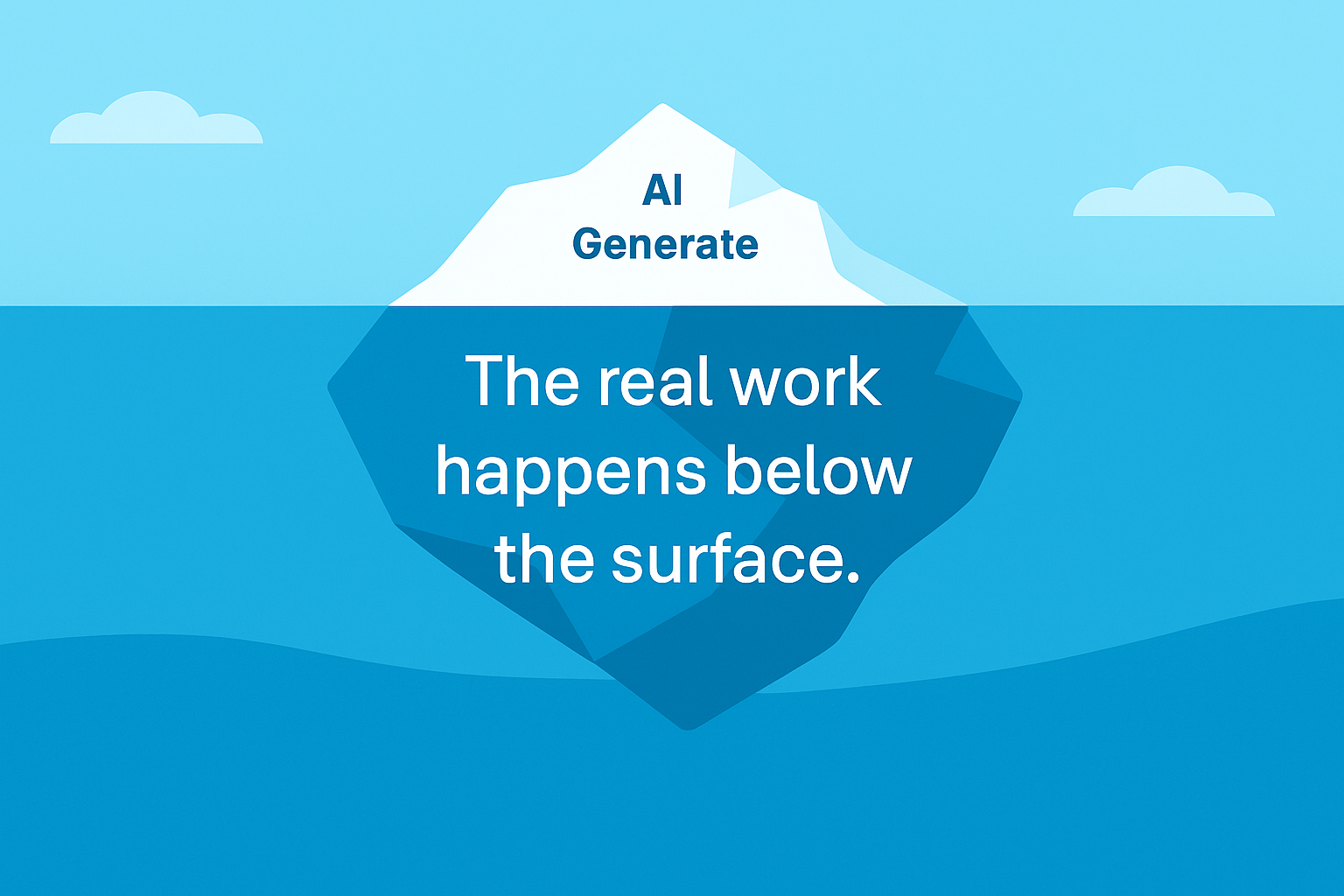
Why the “Just Generate” Approach to AI Falls Short of Real Benefits
I’ve seen several articles with titles that promise four/five-figure monthly passive income streams by using their AI prompts. These prompts all follow the same structure:
- Act as my marketing team and generate five different marketing campaigns to promote my product or service.
- Act as my business strategist and create a complete business process flow for my product and target audience.
- Review my product page and generate multiple blogs to promote it.
You simply slot in your details, and at the end of the month, you supposedly get your four/five-figure passive income stream.
These prompts may seem like they offer instant success and results, but they assume you already have a massive online presence and following.
On top of that, you haven’t given AI much to work with. Everything AI produces might look polished, but it often lacks depth and originality. Because it’s trained to predict likely responses, it tends to generate surface-level content that sounds generic and blends in with thousands of similar posts online.
I’m not saying you shouldn’t use AI. But I am suggesting you use AI as a collaborator rather than as a taskmaster.
Key Takeaways
- Generic prompts lead to generic results.
- AI works best when you bring real context and insights.
- Collaboration and iteration are essential for producing useful outputs.
What does AI as a collaborator look like?
To answer that, we first need to understand that AI is not Google. We’re used to seeing the blinking cursor and feeling the urge to simply ask it for something: “Give me this,” “generate that.” AI will do it, but it uses vast models of data and weighted probabilities to create the most statistically likely response, which often isn’t the most meaningful one.
AI thrives when you approach it with your pre-existing content and ideas and collaborate with it like you would with a colleague. A prompt might look as follows:
“I’ve created the email campaign attached. I’m pretty sure I’m using the right platforms and targeting the correct audience. I also think the content explains my product well, yet my click-through rate is 0.01%. Can you help me brainstorm what the likely causes are?”
With this prompt, you’re giving AI the best chance to help you improve by providing real information and sharing your insights. AI can now do more meaningful tasks like gap analysis, content critique, or competitor comparison, and give you something actionable to work with.
But it doesn’t stop there. Just like real conversations, the process with AI is iterative. You need to apply critical thinking to the response AI gives you. For example:
- “Is this suggestion really applicable to me?”
- “This option AI gave looks interesting…let’s explore it deeper.”
- “How can I incorporate these suggestions into my existing campaign to test the theory?”
You might even respond to AI by saying you think the most likely strategy is X, which it didn’t mention, and ask why.
This way, you make full use of AI’s potential.
So next time you’re tempted to instruct AI to “just generate,” pause and try a more collaborative approach instead. You’ll get insights that feel more relevant and far more useful in the real world.