Please Remember...
This is a fictional example and not real documentation. The purpose is to demonstrate my technical writing.
← why traditional post-trade processes are a bottleneck | post-trade automation (explanation)
What is Post-Trade Automation?
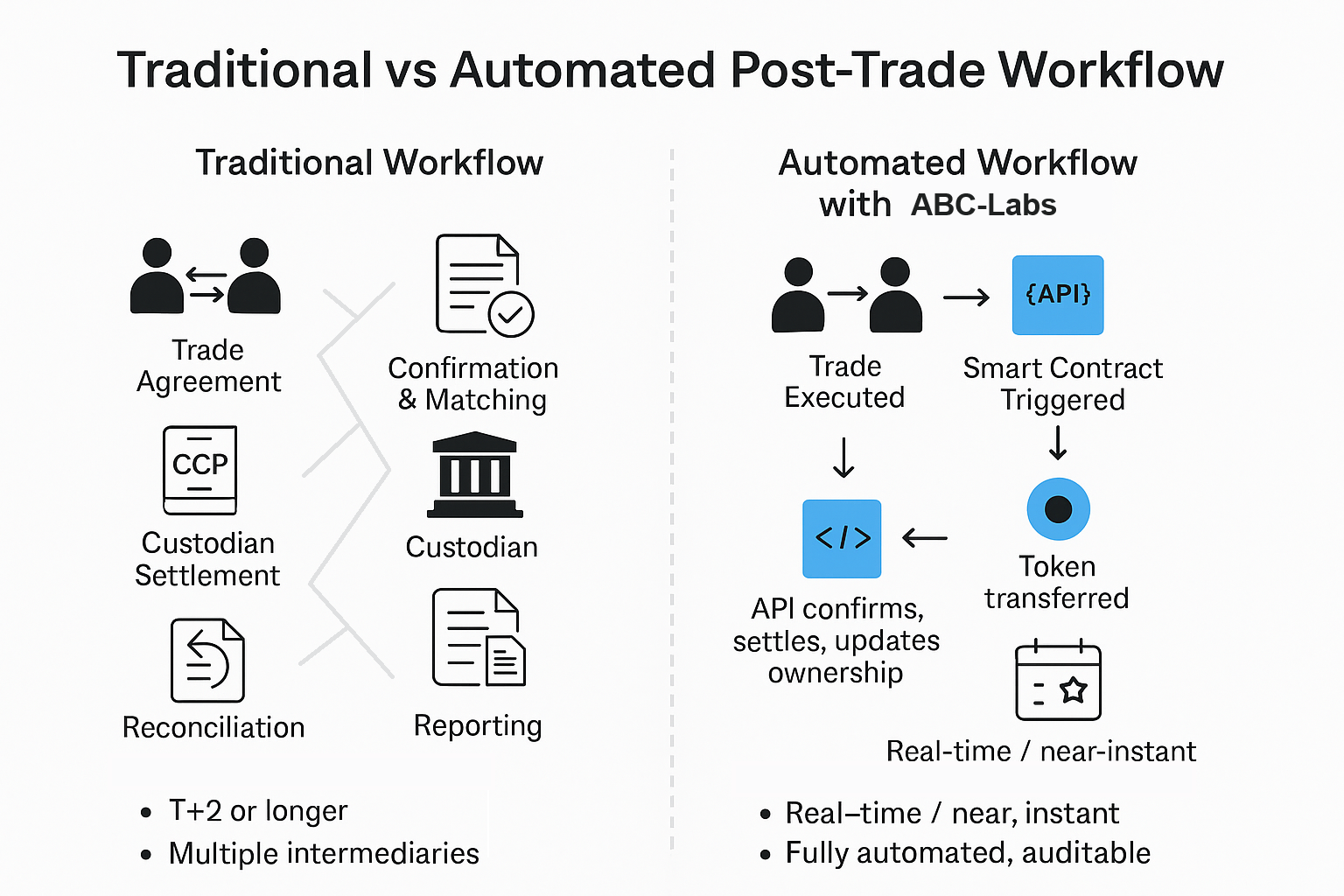
Post-trade automation uses software, APIs, and distributed ledger technology (DLT) to digitise and streamline post-trade steps.
Instead of relying on legacy infrastructure, automation allows:
- Real-time asset transfer and ownership updates
- Pre-programmed workflows for settlement and maturity
- Instant reconciliation via shared ledgers
- Fully traceable actions via audit-ready APIs
In this model, APIs become the new rails, handling trade confirmations, settlements, redemptions, and reconciliations digitally, with minimal manual input.
Below is a comparison between traditional post-trade activities and automated post-trade activities:
| Step | Traditional Post-Trade | Automated Post-Trade |
|---|---|---|
| 1. Trade Agreement | Trade agreed via platforms (e.g., Bloomberg), confirmed via messaging. | Trade terms encoded in a smart contract and executed via digital signature. |
| 2. Trade Matching | Matching engines (e.g., MarkitWire) verify both sides' inputs. | No matching required. Shared contract logic ensures alignment. |
| 3. Clearing | Central Counterparty (CCP) manages risk and becomes the trade counterparty. | Smart contracts can enforce margin and settlement logic, even without a CCP. |
| 4. Collateral Mgmt | Managed through messages and manual instructions. | Automated margin escrow and margin calls handled by smart contract logic. |
| 5. Settlement | Delayed and routed through custodians and clearing banks. | Instant atomic settlement triggered by smart contract on maturity/event. |
| 6. Reconciliation | Involves reconciling multiple internal records; prone to mismatch. | Single source of truth on-chain; no reconciliation needed. |
| 7. Reporting | Regulatory reports compiled and submitted from internal systems. | On-chain data enables real-time, immutable regulatory reporting. |
| 8. Lifecycle Mgmt | Events like resets or coupon payments require manual monitoring. | Smart contracts manage all lifecycle events automatically. |
What comes next?
Related Reading
- Token Lifecycle: Learn how tokens are minted, transferred, queried, and burned throughout their lifecycle.
- How-To Guides: Step-by-step examples with code snippets for each major token operation.
- API Reference Guide: Detailed overview of endpoints, request payloads, and response formats.
- Glossary of Key Concepts: Definitions and explanations of common terminology used throughout the docs.